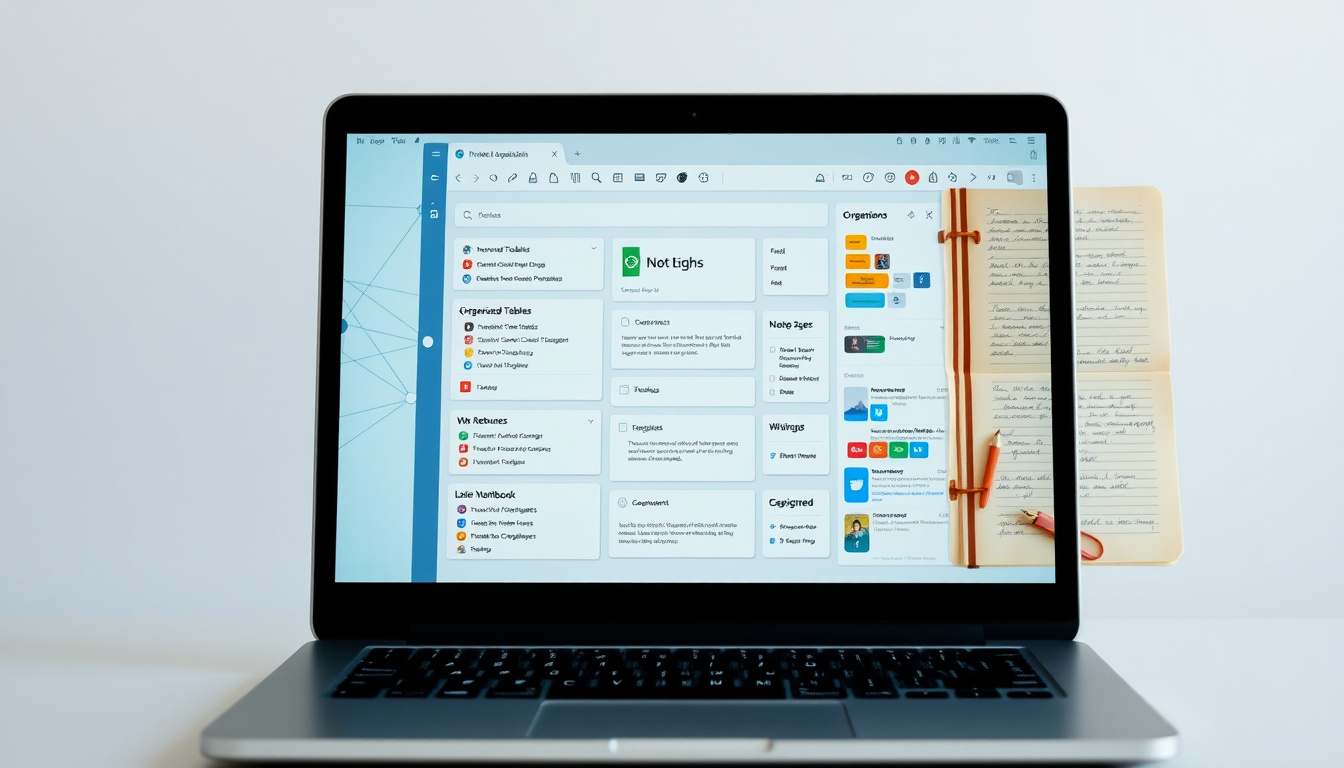
I've spent the last six months living in three different note-taking ecosystems simultaneously. Not by choice — by necessity. I needed to know which one actually deserves the mental real estate we're all fighting to protect.
Here's the honest part: there's no single winner. But there are three very different bets you can make, and each one will change how you actually think and organize your life.
Let me walk you through exactly how I use each one, where they break, and why I'm still not 100% sure I made the right call.
Notion: The Overachiever That Wants to Replace Your Entire Life
I opened Notion on a Monday morning with zero setup. That was my mistake. By Wednesday, I'd built a personal CRM, a project tracker, a reading list, a habit dashboard, and a decision matrix. By Friday, I realized I'd spent 8 hours configuring it and written exactly 3 actual notes. Here's how Notion actually works if you're starting from scratch: **The Setup I Actually Use:** 1. I opened Notion and clicked "Start writing" — it drops you into a blank page 2. I created a simple database called "Daily Notes" by typing `/database` and selecting "Table" 3. Added properties: Date, Tags, Mood, Word Count 4. Created a template for each new entry so I don't have to think about structure The moment this clicked for me was when I stopped trying to build the "perfect system." I use Notion for three things now: - **Daily standup notes** — what I'm working on, blockers, wins - **Project tracking** — databases linked to each other (projects → tasks → notes) - **Long-form writing** — when I need to write something longer than a paragraph The problem: Notion is *slow*. On my MacBook M1, it takes 3-4 seconds to load a page. On my phone, it's laggy enough that I don't bother. If you're someone who types quickly and thinks in bursts, this friction matters. By the time Notion loads, I've already forgotten the thought.What Notion Does Brilliantly
Linking is the superpower here. I can write a note, mention a project, and Notion automatically creates a backlink. This means my notes actually talk to each other without me micromanaging tags and folders. The database feature is legitimately powerful. I created a database of books I'm reading, linked it to notes where I mention those books, and now every book I reference automatically shows me all my thoughts on it in one place. Templates save time. I have a template for meeting notes (date, attendees, action items, follow-up) that auto-fills when I create a new one.Where Notion Falls Apart
The learning curve is real. I watched three YouTube tutorials before I understood that "database" and "table" were sometimes the same thing but not always. This matters if you're just trying to write. Offline doesn't exist. You need internet. Period. I was in a train in India with spotty WiFi and couldn't access my notes. Evernote's offline mode would have saved me there. Pricing stings after the free tier. You get one "workspace" free (which is actually quite generous), but if you want to organize projects separately or share workspaces, you're paying $10/month. For a student? That adds up.Obsidian: The Nerd's Paradise (If You're Willing to Build It Yourself)
Obsidian arrived in my life with a warning from a friend who said, "You're going to love this or abandon it in two weeks." I loved it. But I also cursed at it for three days. Here's the walkthrough: **Day 1 — The Initial Setup:** 1. Downloaded Obsidian (free, though they ask for $40 donation — I paid it) 2. Created a local vault (that's just a folder on my computer) 3. Created my first note with the `.md` extension (Markdown) 4. Discovered you can link notes using `[[double brackets]]` The difference between Obsidian and Notion hit me immediately: Obsidian is *yours*. It lives on your computer. No cloud overhead. No loading time. I click and it opens. Instantly. **How I Actually Use It:** I use Obsidian as my "second brain" — a place where thoughts live permanently. I have folders organized by area of life: ``` Vault/ ├── Work/ │ ├── Projects/ │ └── Ideas/ ├── Writing/ ├── Learning/ └── Personal/ ``` Every morning, I open Obsidian and add to my "Daily Note." It auto-timestamps and auto-links to other notes I mention. When I write about, say, "building better APIs," Obsidian finds all other notes where I've mentioned APIs and shows them in a "backlinks" panel. This is how you actually *remember* what you've learned. It's not just a note app — it's a thinking tool.The Moment It Clicked
I was writing about "focus modes" in productivity apps. Obsidian showed me I'd written about focus three months ago. I'd completely forgotten. The backlinks panel surfaced that connection. Now I have a graph view showing how all my notes relate to each other — it looks like a neural network, which is kind of the point. This is what Obsidian gets right that Notion doesn't: it assumes your thoughts are interconnected. Because they are.Where Obsidian Makes You Work
There's no default sync to cloud. If you want your notes on your phone, you need to pay for Obsidian Sync ($8/month) or use a third-party solution (iCloud Drive, Dropbox, Git). I use Dropbox, which works, but adds complexity. The learning curve is steeper than it should be. Markdown isn't hard, but plugins, settings, and YAML frontmatter confused me for a week. There's no "Start writing" moment. You have to build your system first. The plugin ecosystem is overwhelming. I installed 12 plugins before realizing I actually need 3. It's powerful, but the paradox of choice is real.
Pro Tip: If you're starting with Obsidian, use the "Obsidian 81 Days" vault template. It's a pre-built structure that teaches you how to use the app without you having to build from zero. You can always customize later.
Evernote: The Forgotten Veteran That Still Works
I almost skipped Evernote. Big mistake. Evernote has been around since 2000. It's the grandfather of note-taking apps. Most people using it today are people who started using it in 2011 and never left. That probably tells you something. I approached it with prejudice. Isn't Evernote... dated? No. It's reliable in a way that actually matters. **The Actual Setup:** 1. Opened the app, created a notebook called "Inbox" 2. Clicked the "+" button, wrote a note 3. Chose a notebook (I have: Work, Personal, Learning, Writing) 4. Added a tag (tags are searchable, hierarchical) 5. Searched later using `notebook:Work tag:urgent` The experience is... boring. In a good way. It doesn't try to be a database or a wiki or a project manager. It's a filing cabinet that syncs to the cloud. Here's what surprised me: Evernote's offline mode actually works. I was on a flight, wrote seven notes in airplane mode, and they synced perfectly when I landed. Notion's airplane mode? It's just a white screen.Why Evernote Wins Specific Use Cases
**Clipping from the web:** I use the Evernote Web Clipper to save articles. Click once, choose which notebook, done. Notion requires you to manually copy-paste or use a complex setup. Obsidian doesn't have this built-in at all. **On mobile, it's actually usable:** I can open Evernote, write a quick note, add voice notes (yes, voice notes work), and move on. The app isn't fighting me. **Search is powerful.** I can search by date, location (if you enable it), tags, and content. It's not fancy, but it actually finds what you're looking for.The Honest Limitations
It feels old. The interface isn't ugly, but it's not delightful either. After using Notion's minimalism or Obsidian's modern aesthetic, Evernote feels dated. Organization is limited. You have notebooks and tags. That's it. No relational databases, no templates (well, there are some, but they're clunky), no linking between notes the way Obsidian does it. Pricing is weird. Free tier gives you two devices. Want three devices? $12/month. It's not expensive, but it feels arbitrary.Head-to-Head: What Actually Matters
| Feature | Notion | Obsidian | Evernote |
|---|---|---|---|
| Offline Access | Limited | Full | Full |
| Speed | Slow | Instant | Fast |
| Mobile Experience | Decent | Limited | Excellent |
| Learning Curve | Medium | High | Low |
| Web Clipping | Manual | Limited | Native, Excellent |
| Linking Notes | Database relations | Backlinks (Best) | Tags only |
| Free Tier Value | Excellent | Complete | Limited (2 devices) |
| Best For | Projects, Databases, Teams | Knowledge Base, Learning | Quick Notes, Web Clips |
My Take
I used to think one app could rule them all. I was wrong. After six months, here's what I've learned: **I actually need all three**, but for different things. I use **Obsidian as my thinking tool** — it's where ideas go to evolve. The backlinks force me to make connections I wouldn't otherwise make. It's become my "external brain" in a way Notion never was. The fact that it's offline and fast means I'm not fighting the tool while I think. I use **Notion for projects and teams** — when I need to organize something with other people, track deadlines, and see status at a glance. It's overkill for personal notes, but perfect for "let's build something together." The database feature actually shines here. I use **Evernote for capture** — I clip articles, save voice notes, quickly jot things down on my phone without friction. It's the "inbox" that everything funnels through. What surprised me most: **I thought Evernote was dead.** It's not. It's unfashionable. But it's reliable in a way that matters when you're trying to actually *use* a tool instead of *managing* it. What disappointed me: **Notion's speed.** For an app that costs money (after free tier), it shouldn't feel sluggish. Also, I built a beautiful system and used it for two weeks before reverting to simple text documents. Notion's power becomes a liability if you overthink it.Verdict
**For students:** Use Obsidian. Free, doesn't require internet while studying, and forces you to actually organize your thinking. The learning curve is worth it once. **For working professionals managing projects:** Use Notion. Yes, it's slow. But the ability to create databases, link projects to tasks to notes, and share with your team is worth the friction. Spend $10/month. It pays for itself in saved meetings. **For people who just want something that works:** Use Evernote. Stop overthinking it. Clip articles, write notes, search later. It's not sexy, but it won't waste your time either. **For the obsessive note-taker:** Use Obsidian + Evernote. Obsidian for thinking, Evernote for capture. Build the system you actually want to use. The real answer: try all three free for a week. See which one you actually open instead of the one you think you *should* use. That's your winner.Published by Dattatray Dagale • 23 July 2026









0 Comments