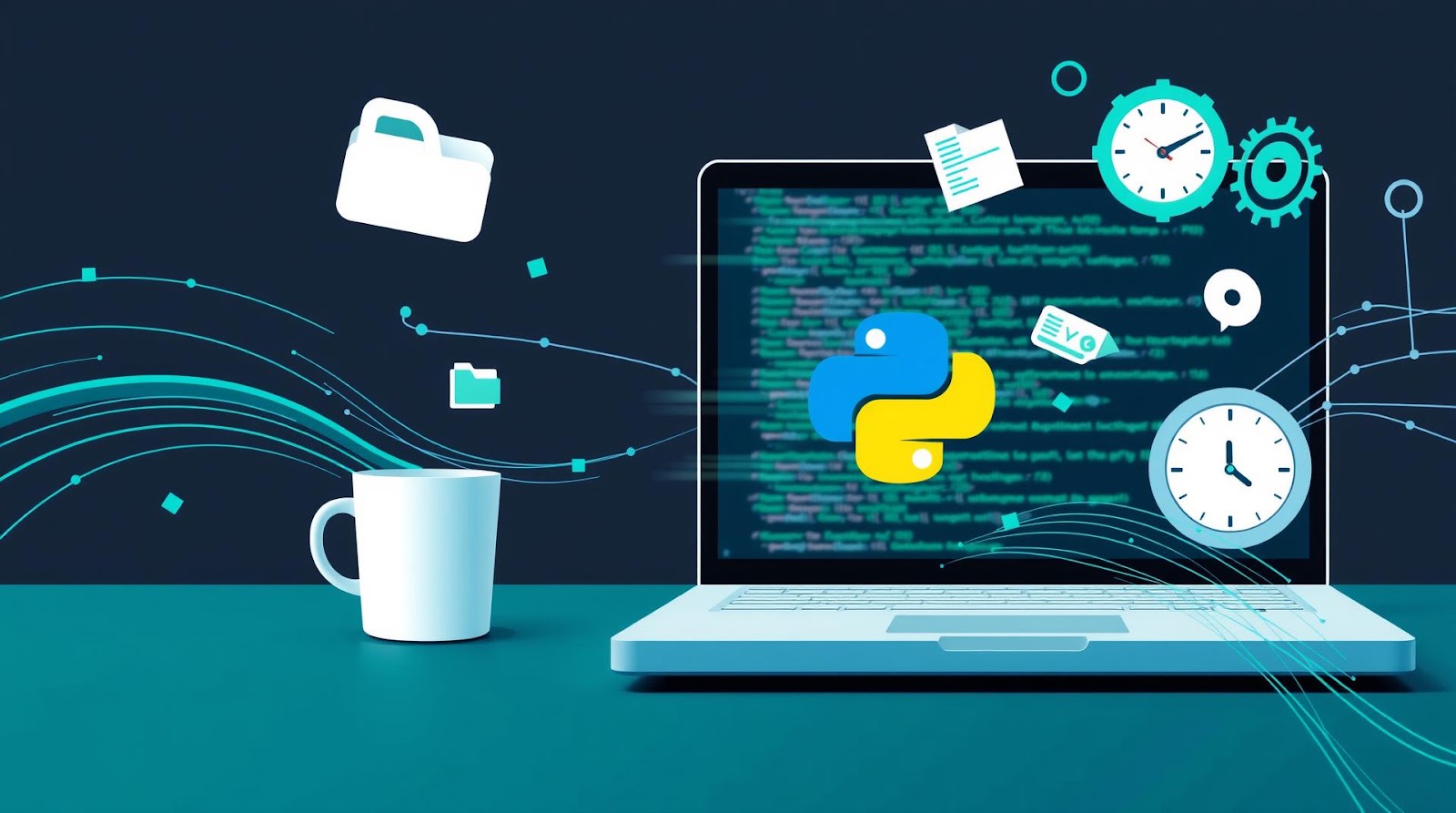
I spent three months manually downloading expense reports, renaming files, and copying data between spreadsheets. Every single week. Two hours minimum. It was soul-crushing work—the kind that makes you want to throw your laptop out the window at 4 PM on a Friday.
Then I learned Python automation. Not the complex stuff. Just simple scripts that took me maybe 30 minutes to write. Now those tasks run themselves.
Here's the thing nobody tells you: you don't need to be a "real programmer" to automate your life. You need maybe 20 lines of code and realistic expectations.
Why Python Is Actually Perfect for This (And Why I Used to Dismiss It)
I used to think automation meant writing elegant, complex code. Turns out, automation is just about being lazy in the smartest way possible.
Python wins here because:
It reads like English. Seriously. `if file_size > 100: move_file()` — you already know what that does. Other languages make you jump through hoops just to move a file.
The libraries are absurdly good. Need to work with PDFs? There's a library. Emails? Library. Excel sheets? Multiple libraries fighting each other for your attention. This matters. A lot. I spent two weeks trying to do something similar in Java once. Never again.
It's forgiving. Python doesn't judge you. You can write messy, imperfect code and it'll still work. That's not a feature in most programming languages—it's considered bad practice. But for automation? Perfect. You're not building a bank's software. You're just automating your own tedious work.
The real advantage is that you can write something useful before breakfast. Seriously.
The Honest Reality: What Python Automation Actually Looks Like
The Tasks That Actually Make Sense
Not everything deserves automation. I see people spending days writing scripts to save 10 seconds of work. That's the opposite of helpful.
Here's what's worth automating:
Repetitive file operations. Renaming 200 photos by date. Moving files from Downloads to specific folders based on type. Combining multiple Excel sheets into one. These are Python's bread and butter, and honestly, they're the reason I started learning in the first place.
Data entry and copying. If you're doing the same data entry every week—pulling numbers from one place, putting them somewhere else—automate it. I automated pulling bank statements and organizing receipts by category. Cut my monthly bookkeeping time from 45 minutes to 2 minutes (the 2 minutes is just verification).
Scheduled checks and alerts. "Tell me if the price of this laptop drops," or "Email me when this website updates," or "Download all new files from this folder every morning." These are stupid-easy with Python and genuinely life-changing.
Things you forget to do. For me, it was backing up important files. I kept forgetting. Now a Python script does it automatically every Sunday at 2 AM. I don't think about it. My data is safe. Problem solved.
The Tasks That Will Waste Your Time (Don't Bother)
Automating something that takes 30 seconds manually is technically possible. It's also stupid.
If the task takes less than a minute and happens once a month, forget about it. If it requires complex logic that would take you a week to debug, maybe that's not the right problem to solve right now. And if the thing you're automating changes every time you do it, you'll spend more time maintaining the script than doing the task would have taken.
I learned this by wasting a full weekend trying to automate something that took 10 seconds. Never again.
Getting Started Without the Overwhelm
Step 1: Install Python (The Easiest Part)
Go to python.org. Download the latest version. Click install. Done. Actually done—no weird configuration nonsense.
If you're on Windows, make sure to check the box that says "Add Python to PATH." This one checkbox saves you an hour of frustration later. Trust me.
Step 2: Pick Your First Real Task (Not a Tutorial)
Don't start with "Hello World." That's useless. Pick something you actually do that annoys you. Right now. This week.
Examples that worked for me and my friends:
- Organizing downloads folder (files everywhere, always a mess)
- Renaming photos with dates
- Extracting text from PDFs
- Checking weather and sending a Telegram message every morning
- Downloading podcasts automatically
Pick one. Something real. Something that will genuinely make your life 1% better.
Step 3: Learn Just Enough (Not Everything)
You don't need to understand object-oriented programming, decorators, or async functions. Forget those words exist for now.
You need to know:
- Variables (just boxes that hold information)
- If statements (if this, then that)
- Loops (do this 200 times)
- How to use libraries (copy-paste code from Stack Overflow)
That's literally it. I'm not exaggerating. I've automated hundreds of tasks with those four things.
Real Examples That Actually Work
Example 1: Organizing Your Downloads Folder
This is the starter script that changed everything for me. Every file gets sorted into folders by type.
The code is basic:
import os
import shutil

downloads_path = "C:/Users/YourName/Downloads"

for file in os.listdir(downloads_path):
    if file.endswith(".pdf"):
        shutil.move(file, "PDFs")
    elif file.endswith(".jpg"):
        shutil.move(file, "Images")
That's it. That code handles PDFs, images, and whatever else. You can run it once a week, or schedule it to run automatically. Your Downloads folder stops being a graveyard.
Example 2: Downloading Files on a Schedule
Want to download all new PDFs from a folder every morning?
import schedule
import time
from your_download_script import download_files

schedule.every().day.at("08:00").do(download_files)

while True:
    schedule.run_pending()
    time.sleep(60)
This runs your download function every single day at 8 AM without you lifting a finger. You can schedule it to run when your computer starts and forget about it entirely.
Example 3: Getting Alerts When Something Changes
I used this to track price drops on products I wanted to buy. The code checks a website, compares it to what I saved before, and sends me a Telegram message if something changed.
The actual implementation depends on what you're checking, but the pattern is always:
Check current state → Compare to old state → If different, send alert → Save new state
That's your automation template for most monitoring tasks.
The Libraries You'll Actually Use
| Library | What It Does | When to Use It |
|---|---|---|
os, shutil |
File operations (move, copy, delete, organize) | Literally always. This is your starting point. |
openpyxl, pandas |
Reading and writing Excel files | When you're pulling data from or pushing data to spreadsheets |
requests |
Downloading files from the internet | Every time you want to grab something from a website |
smtplib, email |
Sending emails automatically | Alerts, reports, notifications (warning: Gmail makes this annoying) |
schedule |
Running code on a schedule | When you want something to happen automatically at specific times |
BeautifulSoup |
Extracting data from websites | Web scraping (read the website's terms first though) |
These six libraries cover like 80% of what people actually automate. Don't overwhelm yourself learning 50 libraries. Learn one, use it, then learn the next one when you need it.
The Mistakes I Made So You Don't Have To
Automating too early in the process. I tried to automate everything before I even understood the problem. Write it manually first. Do it a few times. Then automate. You'll write better code.
Not testing on a copy. I once deleted important files because my script had a bug. They were recoverable, but it was panic-inducing. Always test on duplicates first.
Forgetting about edge cases. "What if a file has a weird name?" "What if the website is down?" "What if the file is 0 bytes?" These things happen. Make your scripts handle them gracefully (or at least fail loudly so you know something broke).
Over-engineering solutions. I spent a week building a "perfect" file organizer when a 10-line script would've solved 90% of the problem. Perfect is the enemy of done. Done is the enemy of doing nothing.
Not documenting what the script does. I wrote a script eight months ago. Now I have no idea what it does. Add comments. Future you will appreciate it.
My Take
Python automation gets hyped as this magical solution that'll free up 20 hours a week. That's not real. What's real is this: you pick three annoying tasks, you write three scripts, and you save about 4-6 hours per month doing things that genuinely matter.
The bigger win? The mindset shift. Once you automate one thing, you start seeing everything differently. "Wait, I'm copying this data manually every week? Let me write a script." It compounds.
What surprised me is how much joy there is in it. You write 20 lines of code, run it, and watch it do an hour's worth of work in 30 seconds. It's weirdly satisfying. There's a reason I've written 70+ automation scripts since that first file organizer—it's not because they all save huge amounts of time. It's because it feels like having a personal assistant.
The disappointment? People oversell this as "no coding experience required." It's more like "minimal coding experience required." You'll need to debug things. You'll get errors. You'll Google them. That's fine. But it's not "click a button and magic happens."
This is for people who are comfortable with a bit of trial and error, who can read documentation, and who genuinely have repetitive tasks that annoy them. If that's you? Start today. Pick one task. You'll be done by this weekend.
Verdict
Learn Python for automation if you have repetitive tasks happening weekly or more often. The ROI is real, especially for file operations, data entry, and scheduled checks. Start with something small, not something perfect. Your first script will be ugly, and that's completely fine.
Skip it if you're expecting zero learning curve or if your annoying tasks only happen once a month. It's not worth your time.
But if you're doing the same thing multiple times a week and it makes you want to scream? Python is your answer. You'll thank yourself after the first script works.
Published by Dattatray Dagale • 14 June 2026








0 Comments