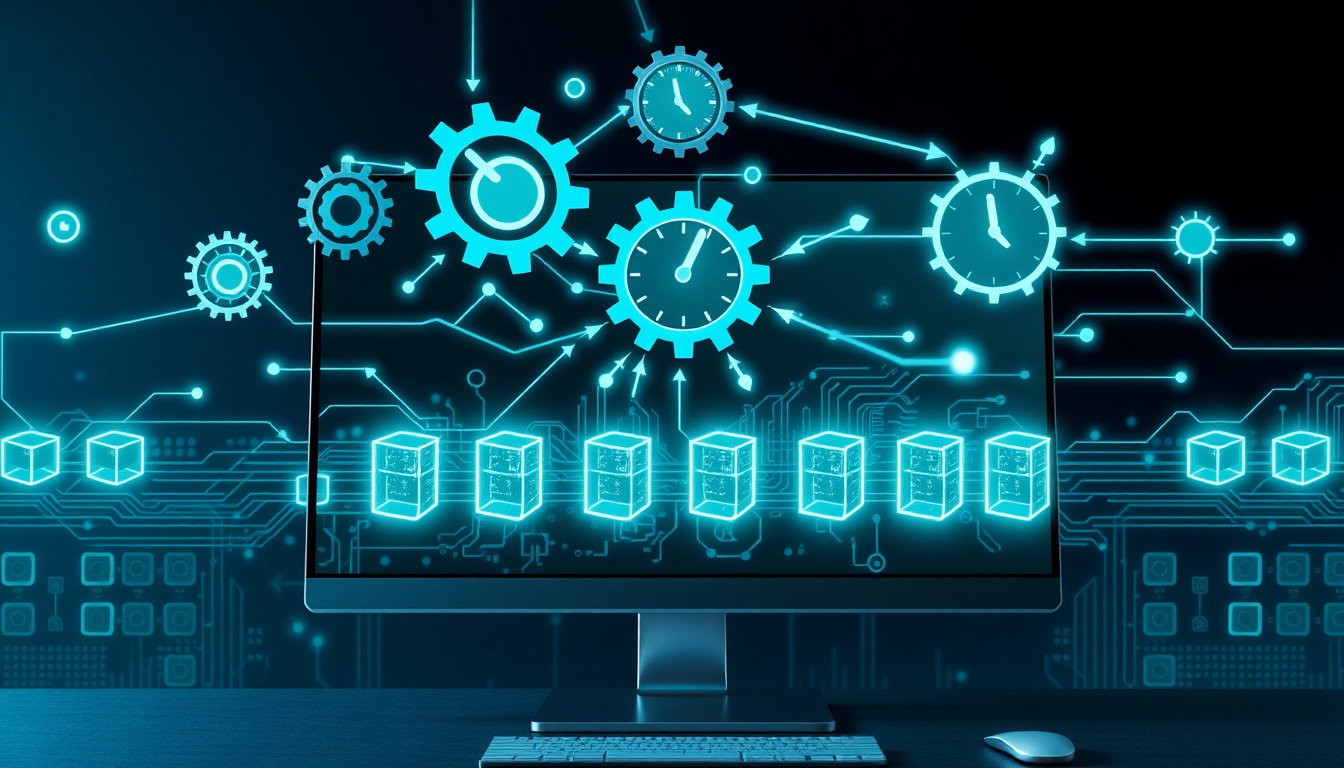
I used to spend my mornings doing the same things every single day. Checking emails. Organizing downloads into folders. Running backups. Renaming files. Copy-pasting data between spreadsheets. It felt like my computer was just… watching me work.
Then I realized something stupid: I was paying for a machine that's literally designed to automate work, and I was using it like a typewriter.
The thing about automation isn't that it requires coding skills or advanced tech knowledge. It doesn't. What it requires is accepting that your repetitive tasks are actually stealing your life. Once you see that clearly, automation stops being a "nice to have" and becomes necessary.
This is what I've learned from actually automating my workflow over the past three years.
Why You're Ignoring Automation (and Why You Shouldn't)
The resistance to automation is real. I get it. There's something about *doing* the task that feels productive. Dragging files feels like work. Clicking buttons feels like effort. And effort feels like accomplishment.
But here's what I realized: that accomplishment is fake. You're not creating anything. You're performing. And the worst part? Most people underestimate how much time these tasks actually consume.
A study I read estimated that office workers spend roughly 28% of their workday managing emails alone. That's not checking emails—that's managing them. Moving them. Organizing them. Responding. If you're working 8 hours, that's 2.2 hours a day. Multiply that by five days, fifty weeks a year. You're looking at 550+ hours annually on email management alone.
Do you know what you could learn in 550 hours? Actually, forget learning. What could you *rest* in 550 hours? That's 23 full days of your life.
Still think automation is optional?
The Automation Myth You Need to Forget
There's this belief that automation is only for "technical people" or that it requires you to learn Python. False. Dead wrong. Most automation happens through tools that literally anyone can use—Zapier, IFTTT, Windows Task Scheduler, AutoHotkey. No coding required.
I'm not a programmer. I run a blog, manage some freelance projects, and I'm always drowning in administrative work. I've automated dozens of workflows. Not one of them required writing code.
The Real Cost of NOT Automating
Here's what I see happen: People spend 15 minutes every morning doing something repetitive. They think, "It's just 15 minutes. No big deal." But 15 minutes × 260 working days = 65 hours a year. That's 1.6 weeks of full-time work spent on something a script could do in 0.1 seconds.
The cost isn't just time. It's mental energy. Every task you do manually is a decision your brain has to make. Even if you do it on autopilot, it's still taking up cognitive real estate. Remove it, and suddenly your brain has space for actual thinking.
The Tools That Actually Work (and Which Ones to Skip)
There are dozens of automation tools out there. Some are incredible. Some are overrated. I've used most of them.
Windows Task Scheduler (Built-In, Free)
This is the one most people don't know exists. It's already on your PC. You can use it to run scripts, launch programs, or execute batch files at specific times or intervals.
I use it to automatically back up my important folders every night at 2 AM. I also use it to run a cleanup script every Sunday that deletes temp files and empties my recycle bin. Set it once, forget it forever. This alone saves me probably 5 minutes a week, which sounds small until you realize that's 4+ hours annually.
The downside? The interface is clunky, and if you want to do complex things, you might need to understand batch scripting or PowerShell. But for basic stuff? Unbeatable.
Zapier (Web-Based, Freemium)
Zapier connects different apps and lets them talk to each other. For example: every time you add a contact to your phone's contact list, Zapier can automatically add them to a Google Sheet. Or every time you get an email from your boss, it flags it and sends you a notification.
I use Zapier to automatically save email attachments from specific senders to a folder in Google Drive. It used to take me 5 minutes a day. Now? Zero minutes. It just happens.
Free plan is decent—you get 100 tasks a month, which is enough if you're not doing anything crazy. Paid plans are $20-$99/month depending on what you need.
AutoHotkey (Windows, Free, Open-Source)
This is for people who want to get their hands a bit dirtier. AutoHotkey lets you write scripts that automate keyboard and mouse actions. It's simple syntax, easy to learn, and incredibly powerful.
I wrote a 5-line AutoHotkey script that types out my email signature with a keyboard shortcut. I also have one that reorganizes my downloads folder. There are thousands of example scripts online. Most people can copy, paste, and modify existing scripts without knowing what they're doing.
The only caveat: it's Windows-only. If you're on Mac, you'll want to look at Automator instead.
IFTTT (Web-Based, Freemium)
IFTTT (If This Then That) is simpler than Zapier but less powerful. It's great for straightforward integrations—like sending yourself a reminder on your phone when someone mentions you on Twitter, or logging your Gmail contacts to a spreadsheet.
I used to use this more, but honestly, Zapier has better integration options for serious automation. IFTTT feels more like a "fun automation" tool than a productivity tool. That said, it's free and easy, so why not try it?
| Tool | Best For | Cost | Learning Curve |
|---|---|---|---|
| Windows Task Scheduler | File backups, cleanups, running programs | Free | Medium |
| Zapier | Connecting web apps, data workflows | Free - $99/mo | Very Easy |
| AutoHotkey | Keyboard shortcuts, mouse automation | Free | Easy-Medium |
| IFTTT | Simple app integrations, notifications | Free - $9/mo | Very Easy |
What Actually Works (Real Examples)
Theory is fine. Let me show you what I actually automate, and how much time it saves.
Email Management (Before: 45 min/day, After: 5 min/day)
I used to manually sort emails into folders based on sender or topic. Mindless work, but necessary. Now? I use Gmail filters combined with Zapier.
Gmail filters automatically label and archive emails based on rules I set (newsletters go to one label, client emails go to another, etc.). Zapier then takes important emails and sends them to my Slack as notifications. Everything else gets handled passively.
Result: I check email once a day for 5 minutes instead of constantly throughout the day. My brain isn't interrupted every two minutes by a ping. And I never miss important stuff because it hits my Slack.
File Organization (Before: 20 min/week, After: 0 min/week)
My downloads folder used to be a graveyard. I'd let files pile up, then spend 20 minutes every Friday organizing them into the right folders.
Now? Windows Task Scheduler runs a batch script every Friday at 5 PM. It moves PDFs to my "Documents" folder, images to "Photos," and everything else to an "Archive" folder organized by date. My downloads folder is literally never messy.
The script took me 30 minutes to write. It's saved me approximately 1,040 minutes (17+ hours) since. Good investment.
Data Entry (Before: 30 min/week, After: 2 min/week)
I track freelance project hours in a Google Sheet. Used to be, I'd get an invoice from a client, manually copy the hours into the sheet, and then calculate totals. Repetitive and error-prone.
Now I use Zapier to automatically add entries from my email to the Google Sheet, and Google Sheets formulas calculate everything. When an invoice comes in, I just add one tag to it in Gmail. Done.
This alone probably saves me 90+ hours a year. And I make fewer data-entry errors, which means fewer awkward corrections with clients.
The Pitfalls (Because Not Everything is Golden)
Automation isn't a magic fix. There are real downsides you need to know about.
Automation Can Break (And Then You're Confused)
I set up a Zapier workflow to automatically save important emails to Notion. Worked great for three months. Then Zapier updated their interface, the integration broke, and I didn't notice for a week. I missed emails.
The fix was easy once I found the problem, but the lesson stuck: automated systems need occasional check-ins. At least once a month, verify that your automations are still running. Set a calendar reminder. Seriously.
Over-Automation Can Make You Inflexible
I once automated a workflow so aggressively that when I needed to change how something worked, I had to unwind three different automations. It took longer to fix than if I'd just done the task manually.
Rule of thumb: automate repetitive *and* predictable tasks. If the task has too many variables or exceptions, automation creates more work than it saves.
The Setup Tax
Building automations takes time upfront. The question is: will the time saved exceed the time invested in setup? For a task you do once a year, probably not. For something you do multiple times weekly, absolutely.
Do the math. If a task takes 10 minutes to automate but only saves you 2 minutes a month, skip it. But if it saves 5 hours a year? That's worth an hour of setup time.
Where to Start (A Practical Roadmap)
This is the part where I'd normally give you a step-by-step guide. I'm not going to. Why? Because your repetitive tasks are probably different from mine. Instead, here's how to think about it.
Step 1: Audit Your Week
Spend one week tracking every task that takes more than 2 minutes and is exactly the same every time you do it. Write them down. Include the time spent.
Step 2: Rank by Time Saved
Which task would save you the most time if automated? Start there. Ignore the "easy" automations. Go for high impact.
Step 3: Choose the Right Tool
Refer back to the tool comparison table. Pick one tool. Spend 30 minutes learning it. Not hours. Thirty minutes.
Step 4: Build One Automation
Build your first automation. Expect it to take longer than you think. Test it. Make sure it actually works. Then move on.
Step 5: Document It
Write down what you automated and how. Future you will thank current you when something breaks and you need to fix it.
My Take
I used to think automation was a luxury—something for "power users" or people who had time to tinker. I was wrong. It's fundamental.
What surprised me most isn't how much time I saved (though the math is stunning). It's how much *mental energy* I recovered. Before automation, my brain was constantly context-switching between "actual work" and "managing the work." Removing that friction made me sharper and happier.
What disappointed me: most people I mention this to don't care. They've internalized that repetitive work is "just part of life." It's not. It's a choice. And it's a choice I think is worth rejecting.
This is for anyone working on a computer—students managing assignments, freelancers managing clients, office workers managing emails, anyone. If you feel busy but unaccomplished at the end of the day, you're probably drowning in tasks that could run themselves. Start there.
Verdict
Automation is not optional. It's not a nice-to-have. It's a skill that should be as basic as knowing how to use email.
Start today. Pick one task. Spend one hour learning a tool. Build one automation. You'll immediately understand why I'm pushing this so hard.
And in six months, when you've automated a dozen workflows and reclaimed roughly 100+ hours of your life? You'll wonder how you ever worked without it.
That's not hyperbole. That's math. And math doesn't lie.
Published by Dattatray Dagale • 30 July 2026








0 Comments