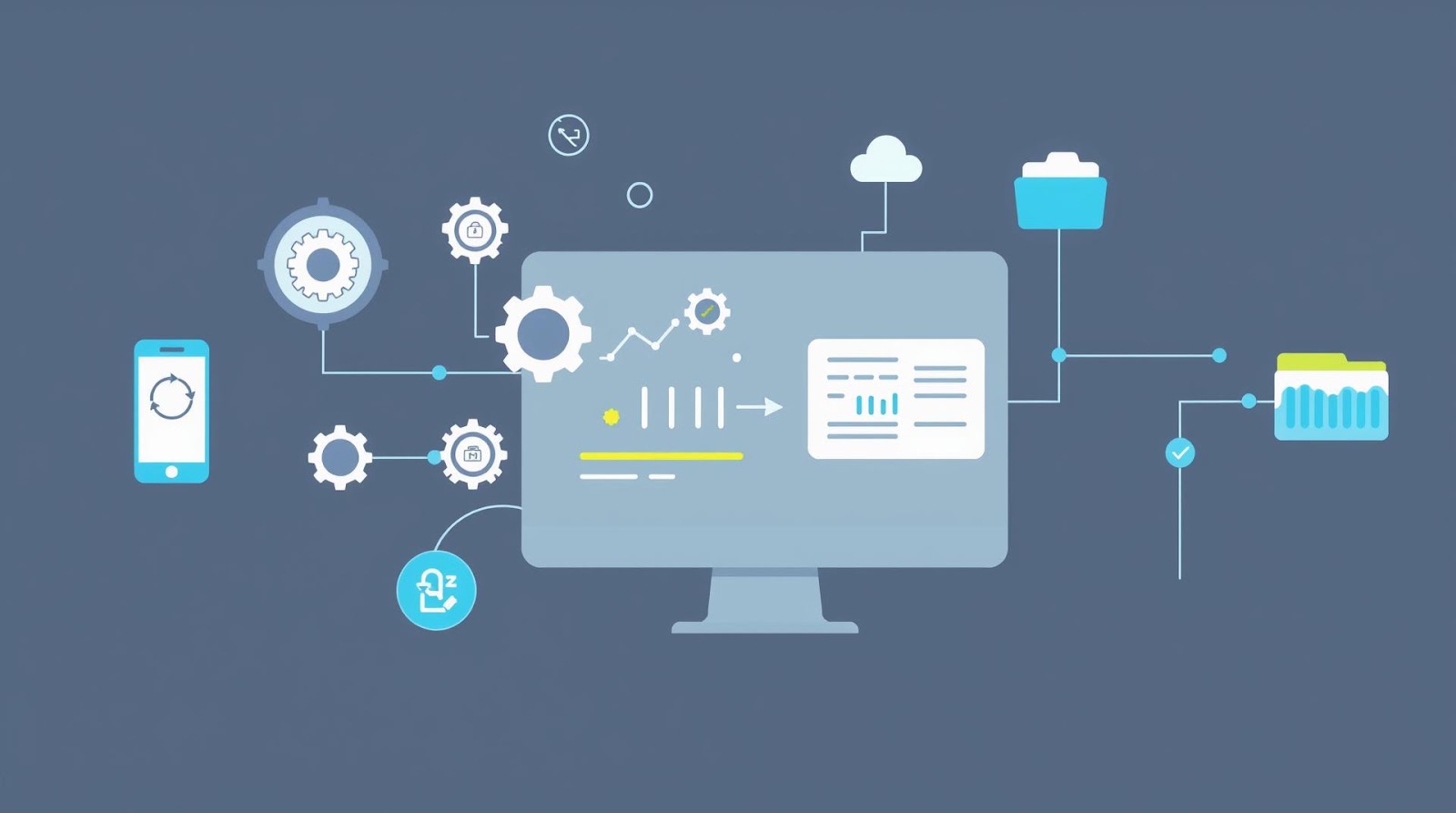
I used to spend roughly 90 minutes every single day on tasks that a computer should have been doing for me. Copy-pasting data between spreadsheets. Renaming files in bulk. Sending the same email responses. Organizing downloads into folders. Nothing complicated, but repetitive enough to drain my focus before noon.
So I decided to test automation tools properly—not just watching YouTube tutorials, but actually building workflows, hitting walls, and seeing what stuck. After three months of experimenting with six different approaches, I've figured out what genuinely works, what's overhyped, and what's only worth it if you're already a technical person.
Here's what I learned.
The Automation Landscape Is Messier Than You'd Think
When I started, I thought automation meant hiring someone to write code. That's not true anymore—though it's also not as simple as just clicking a few buttons like some tools promise.
The reality is there's a spectrum. On one end, you have no-code tools like Zapier or IFTTT where you literally connect apps visually. On the other end, you have PowerShell scripts or Python that require actual programming knowledge. In the middle, there are tools like AutoHotkey or Macro Recorder that let you record your mouse clicks and play them back—which sounds great until you realize clicking works only if windows are exactly the same size and your cursor is in the exact position (spoiler: it never is).
I tested tools across this entire spectrum. Some surprised me. Most disappointed me in specific ways.
The Tools I Actually Used (And What Happened)
Zapier—For Cloud Tasks, Not Your Desktop
Zapier gets all the attention. It's beautiful, it works well, and it handles cloud-based automation like nobody's business. I set up a workflow where every time I saved a file to a specific Google Drive folder, it would automatically upload it to a cloud storage backup and send me a Slack notification.
Worked flawlessly. Zero complaints.
But here's the thing: Zapier can't automate things on your actual PC. It works with web apps and cloud services. If your repetitive task involves opening a desktop application, editing a local file, and saving it—which mine did—Zapier won't help. Their free tier lets you run 100 tasks per month. Their paid plan is ₹600+ monthly for the cheapest tier. For casual PC users, that's just too much.
Microsoft Power Automate—Promising But Confusing
I used to think Power Automate was just for Office workers. I was half-right.
It integrates beautifully with Excel, Outlook, Teams, and OneDrive. I built a workflow that automatically filed emails into folders based on keywords and added relevant tasks to my To Do list. That actually worked. The interface is cleaner than I expected, and it's included free with Microsoft 365 subscriptions (or free for basic use).
But the moment I tried to automate something on my desktop—like batch-processing screenshots or organizing files from my Downloads folder—Power Automate hit its limits. It's designed for cloud-first workflows. For PC automation, it's missing pieces.
I could be wrong here, but I think Power Automate is genuinely useful only if you're already in the Microsoft ecosystem and doing most of your work in the cloud.
AutoHotkey—Powerful, But I Kept Breaking Things
AutoHotkey is free and lets you write scripts that do literally anything on your Windows PC. I used it to create a keyboard shortcut that would instantly open my five most-used apps simultaneously. That worked perfectly.
Then I tried something more ambitious: automating a repetitive data entry task by scripting specific keystrokes and mouse movements. It worked... sometimes. The second time I resized my window, the mouse coordinates were wrong and the script clicked in the wrong place and somehow opened 47 tabs in my browser (I still don't know how).
The learning curve isn't terrible, but it's real. You need to understand variables, loops, and syntax basics. If you're not already comfortable with code, you'll spend more time debugging than saving time.
Task Scheduler + Batch Files—Boring But Reliable
Windows comes with Task Scheduler built-in. Nobody talks about it because it's ancient and looks like it was designed in 2003. But I used it to automate file cleanup—deleting files older than 30 days from specific folders, compressing large files, organizing my Downloads folder every night at 2 AM.
Wrote simple batch files. No fancy UI. Just DOS commands. And honestly? It worked better than flashier tools. It's not elegant, but it's stable. There's no subscription. It requires basically zero learning if you can copy-paste commands from Stack Overflow.
I used to think batch files were dead technology. I was wrong.
IFTTT—Simple, But Limited by Design
IFTTT (If This Then That) is the easiest automation tool for absolute beginners. You genuinely just click buttons and connect services. I set up a recipe that saved every tweet I liked to a Google Sheet. Took 60 seconds.
But IFTTT is limited by design. It's great for mobile notifications or connecting two simple services. For complex workflows or anything PC-specific, you'll outgrow it immediately. And their free tier limits are tight—5 active applets, limited triggers.
What Actually Worked for My Repetitive Tasks
After all this testing, here's what I ended up using consistently:
For bulk file operations: Task Scheduler + batch scripts. Organized my Downloads every night. Compresses old project folders monthly. Deletes temporary files. Free. Runs automatically. I don't think about it.
For cloud-based tasks: Zapier for connecting services (email to spreadsheet, form submissions to databases). Power Automate for Microsoft Office workflows. Both are reliable and save me the most time—probably 30 minutes daily.
For keyboard shortcuts: AutoHotkey for simple scripts (opening apps, launching custom hotkeys). I use three active scripts. Nothing fancy. They save maybe 10 minutes daily.
For communication: Email filters + templates. Not really automation, but templating common responses saved surprisingly more time than I expected.
The combination of these tools eliminated about 75 minutes of daily busywork. I didn't need to pick the fanciest tool—I needed to pick the right tool for each task.
| Tool | Best For | Cost | Learning Curve |
|---|---|---|---|
| Task Scheduler | File operations, PC cleanup | Free | Medium |
| Zapier | Cloud service integration | $20–50/month | Very Easy |
| Power Automate | Microsoft 365 workflows | Free (with M365) | Medium |
| AutoHotkey | PC hotkeys and scripts | Free | Medium–Hard |
| IFTTT | Simple mobile/web triggers | Free (limited) | Very Easy |
The Tools I Abandoned (And Why)
I tested a few others that didn't make the cut:
Macro Recorder: Records your mouse and keyboard actions. Sounds perfect. Isn't. The second anything on your screen changes position or size, macros break. I spent more time fixing broken macros than I saved from running them.
Make (formerly Integromat): Like Zapier's more technical cousin. Powerful, but the learning curve is steep. The UI confused me. I gave up after two hours.
Selenium or Python scripts: If you know how to code, these are genuinely powerful. For everyone else, skip it. The setup alone took me a full day.
How to Actually Get Started (Without Overwhelming Yourself)
Step 1: Identify Your Actual Bottleneck
Track what you actually do for a day. Not what you think you do—what you actually do. You'll probably be surprised. I thought my biggest time sink was email management. It wasn't. It was file organization and renaming.
Step 2: Pick the Right Tool for That Specific Task
Don't pick the tool first. Figure out what needs automating, then match it to a tool. If it's cloud-based, use Zapier or Power Automate. If it's file operations, use Task Scheduler. If it's keyboard shortcuts, use AutoHotkey.
Step 3: Start Stupidly Simple
My first Zapier automation was just "send me a Slack notification when I get an email from my boss." That taught me how the tool worked. My first batch script just deleted files from one folder. Nothing complicated.
After you get comfortable with simple automation, then try complex workflows.
My Take
Here's my honest verdict: automation tools are genuinely useful, but they're oversold by people trying to make you think you need their specific platform.
The honest truth is simpler. You don't need the fanciest tool. You need to be realistic about what actually wastes your time. For me, that was cloud service connections (Zapier solved it) and file management (Windows Task Scheduler solved it). For you, it might be something entirely different.
What surprised me most was how much I didn't actually save using the fanciest tools. Power Automate and Zapier combined save me about 30 minutes daily. But Windows Task Scheduler—which costs nothing and looks like it's from 2003—probably saves me another 45 minutes through automated cleanup and file organization that just happens in the background.
What disappointed me was how many tools promise "no coding required" but still require you to think like a programmer. You need to understand logic (if X happens, do Y). That's not impossible, but it's not as effortless as the marketing suggests either.
Who is this actually for? Anyone doing the same task more than 3 times per week. Anyone with cloud-based workflows. Anyone willing to spend 30 minutes setting something up to save 5 minutes daily (it pays off). But probably not for people who jump between tasks constantly or work with highly specialized software that doesn't integrate with automation platforms.
Verdict
Use automation, but strategically. Start free. Use Windows Task Scheduler for PC cleanup, Zapier for cloud services, and AutoHotkey only if you're comfortable with basic scripting. Don't chase the trendiest tool—chase the tool that actually solves your specific problem.
I've saved roughly 5 hours per week by automating the right tasks. That's genuinely life-changing. But I got there by testing, failing, and being honest about what actually worked—not by following someone's "ultimate automation stack."
Your automation journey should be equally specific to your life. Start small. Pick one task. Automate it. See if you actually use it. Then scale from there. That's how you actually save time instead of just collecting tools you'll never use.
Published by Dattatray Dagale • 05 July 2026








0 Comments